
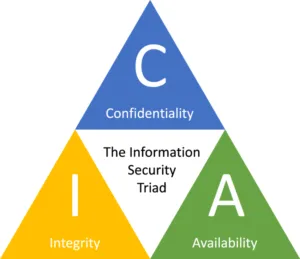
While the term “CIA” might remind you of the U.S. intelligence agency, in cybersecurity, the acronym takes on a different meaning. The CIA Triad is a widely used model guiding organizations in assessing and improving their information security strategies and risk management processes.
| Pillar | What it means | What a breach looks like | Example controls |
|---|---|---|---|
Confidentiality | Only authorized users can access data | Data leak, credential theft, misconfigured cloud storage | Encryption at rest and in transit, MFA, role-based access control |
Integrity | Data is accurate and has not been altered without authorization | Altered records, man-in-the-middle attack, malware corrupting files | Checksums and hashing, immutable audit logs, digital signatures |
Availability | Systems and data are accessible to authorized users when needed | DDoS attack, ransomware, hardware failure, unplanned downtime | Redundancy and failover, tested backups, uptime monitoring |
Why the CIA Triad Matters in Modern Cybersecurity
In today’s threat landscape, filled with ransomware attacks, phishing scams, and data breaches, organizations must build security programs prioritizing data protection, regulatory compliance, and business continuity. The CIA Triad helps companies build a zero trust security framework by addressing the following:
- Confidentiality – preventing unauthorized access to sensitive data.
- Integrity – ensuring information remains accurate and untampered.
- Availability – maintaining reliable access to data and systems when needed.
Breaking Down the CIA Triad in Cybersecurity
Confidentiality in cyber security
1. Confidentiality in Cybersecurity
Confidentiality refers to the protection of sensitive information from unauthorized access or disclosure. Your business needs to enforce extra security measures to ensure your clients and prospects’ privacy is safeguarded. Examples include customer names, email addresses, credit card numbers, and medical records.
Confidential data breach prevention starts by:
- Implementing access control policies based on job roles.
- Using data encryption, both at rest and in transit.
- Deploying multi-factor authentication (MFA).
- Applying zero trust principles to limit lateral movement inside your network.
Common threats to confidentiality:
- Insider threats or privilege misuse
- Social engineering and phishing attacks
- Misconfigured cloud storage
- Accidental data exposure through file sharing
By maintaining strict access policies and using cybersecurity tools like identity and access management (IAM)platforms, you can significantly reduce your risk of a data leak or privacy violation.
2. Integrity in Cybersecurity
Data integrity ensures information remains complete, consistent, and trustworthy throughout its lifecycle.
Best practices to preserve data integrity:
- Enable automated data backups
- Use audit logging and change monitoring
- Implement digital signatures and hashing techniques
- Validate software and system updates
Examples of integrity attacks:
- Email fraud attacks
- Financial fraud
- Manipulation of healthcare records
- Malware targeting system files or firmware
Maintaining data integrity is essential for making informed business decisions, protecting brand trust, and ensuring compliance with international cybersecurity regulations.
3. Availability in Cybersecurity
Availability means your systems and data must be accessible when needed, whether during normal operations or in the face of a cyber attack, power outage, or natural disaster.
Strategies to ensure high availability:
- Use redundant systems and disaster recovery solutions
- Maintain real-time backups
- Deploy cloud infrastructure with failover capabilities
- Regularly patch and update critical systems
Availability threats include:
- DDoS (Distributed Denial-of-Service) attacks
- Ransomware infections locking you out of critical data
- Software bugs or misconfigurations
Investing in network resilience and business continuity planning is key to reducing downtime and ensuring customer trust.
How the CIA Triad Maps to Compliance Frameworks
Every major security and compliance framework is built on the CIA triad. Understanding the triad is not academic — it determines which controls you need to implement and which evidence you need to collect to satisfy an auditor.
| Framework | How the CIA triad appears |
|---|---|
The five Trust Service Criteria (Security, Availability, Processing Integrity, Confidentiality, and Privacy) are a direct extension of the CIA triad. The required Security criterion addresses all three pillars simultaneously. | |
Annex A controls address each pillar separately: access control and cryptography (Confidentiality), integrity of systems and software (Integrity), business continuity and availability management (Availability). | |
NIST CSF | The Protect function addresses confidentiality and integrity controls. The Recover function addresses availability. The full framework is structured around CIA-triad thinking throughout. |
HIPAA | The Security Rule explicitly requires organizations handling ePHI (electronic protected health information) to protect its confidentiality, integrity, and availability. All three pillars are named directly in the regulation. |
If you are working toward SOC 2, ISO 27001, HIPAA, or any other framework, the CIA triad is the foundation your program sits on. Building controls around it from the start means less rework when your auditor asks for evidence.
From Principles to a Working Program
Understanding the CIA triad is the starting point. Implementing the specific controls that satisfy confidentiality, integrity, and availability requirements for SOC 2, ISO 27001, or HIPAA is where most teams get stuck.
Kobalt’s Security Squad handles the gap assessment — mapping your current environment against the CIA triad controls each framework requires — then manages remediation, policy writing, and audit preparation. Your team reviews and signs off. We do the work.
Frequently Asked Questions About the CIA Triad
What is the CIA triad in cybersecurity?
The CIA triad stands for Confidentiality, Integrity, and Availability — the three core principles that define a secure information system. Confidentiality ensures data is only accessible to authorized users. Integrity ensures data is accurate and has not been altered without authorization. Availability ensures systems and data are accessible when users need them. The CIA triad is the foundation of virtually every cybersecurity framework, from SOC 2 and ISO 27001 to HIPAA and NIST CSF.
Why is the CIA triad important?
The CIA triad gives security teams a consistent framework for evaluating risks and designing controls. Every security decision maps back to one or more of the three pillars: does this control protect confidentiality, maintain integrity, or ensure availability? Without this structure, security programs become reactive — patching individual incidents rather than building a coherent defense. For organizations pursuing compliance certifications, the CIA triad is also the basis on which auditors assess whether controls are adequate and purposeful.
What is an example of confidentiality in cybersecurity?
A company storing customer payment data encrypts it at rest and in transit, enforces multi-factor authentication for all employee accounts, and uses role-based access control so only the billing team can view financial records. These controls protect confidentiality by ensuring only authorized individuals can access sensitive data. A breach of confidentiality occurs when data is accessed by someone who should not have it — through credential theft, a misconfigured cloud storage bucket, or an insider threat.
What is an example of integrity in cybersecurity?
A financial services company uses checksums to verify that transaction records have not been altered between systems, maintains immutable audit logs of all database changes, and enforces code signing to ensure software deployments have not been tampered with. These controls protect integrity by detecting and preventing unauthorized changes to data. A breach of integrity occurs when data is modified without authorization — such as a man-in-the-middle attack altering a transaction amount, or malware corrupting production files.
What is an example of availability in cybersecurity?
A SaaS company runs infrastructure across multiple cloud regions with automated failover so that if one region goes down, traffic routes to another without service interruption. They perform daily encrypted backups with tested recovery procedures and a defined RTO (how quickly systems must be restored). These controls protect availability by ensuring the system remains accessible even when components fail. A breach of availability occurs when legitimate users cannot access systems — through a DDoS attack, ransomware encrypting critical data, or hardware failure without a recovery plan.
How does the CIA triad relate to SOC 2 compliance?
SOC 2’s five Trust Service Criteria — Security, Availability, Processing Integrity, Confidentiality, and Privacy — are a direct extension of the CIA triad. The required Security criterion addresses all three pillars: it requires controls that protect confidentiality, maintain data integrity, and ensure availability. Organizations pursuing SOC 2 build their control environment around CIA triad principles, then demonstrate those controls to an independent auditor. The gap assessment Kobalt runs at the start of every SOC 2 engagement maps the client’s current environment against CIA triad controls across all applicable Trust Service Criteria.
What is the difference between confidentiality and privacy?
Confidentiality is a security principle — it means restricting access to data so only authorized users can reach it. Privacy is a legal and ethical concept — it means respecting individuals’ rights over their personal information. Confidentiality is a tool that supports privacy, but the two are not the same. GDPR, for example, is a privacy regulation governing how personal data is collected, stored, and used. SOC 2’s Confidentiality criterion is a security control requiring that data designated as confidential is protected from unauthorized access. A company can have strong confidentiality controls while still having poor privacy practices — collecting data users didn’t consent to share, for instance.
Does the CIA triad cover all cybersecurity risks?
The CIA triad covers the three most fundamental security objectives, but it is a framework, not a complete control catalog. Modern threat models — supply chain attacks, AI-generated phishing, zero-day vulnerabilities, and insider threats — require controls that build on top of the triad rather than replace it. Frameworks like NIST CSF and ISO 27001 extend the triad with additional categories: governance, incident response, supplier risk management, and resilience. The CIA triad is the right starting point for building a security program; a managed security program is how you operationalize it.