
Why Compliance Across APAC Is Challenging
The Asia-Pacific region presents a unique challenge for businesses with its patchwork of data protection laws. Each country—whether Singapore with the PDPA, Thailand with its Data Protection Act, or Australia with its evolving Privacy Act has developed specific data management, privacy, and breach reporting regulations.
While these frameworks aim to protect individuals’ data, the requirements are not uniform, making cross-border compliance an intricate task. For businesses, this translates to the need for flexible compliance strategies that can adapt to varying legal expectations across each jurisdiction, often leading to higher operational costs and resource demands.
Harmonizing these diverse requirements while remaining compliant can be a challenging task, particularly as data privacy expectations continue to evolve across the region.
Compliance as a Trust Signal
For companies operating in APAC, meeting these regulatory requirements is more than just a legal formality—it’s a way to show commitment to customer privacy. Inconsistent data privacy regulations across the region mean that any misstep in one country can impact a company’s reputation in others.
Customers today are increasingly aware of data privacy issues and value transparency from the organizations they interact with. Businesses prioritizing strong data protection practices demonstrate responsibility, setting themselves apart as trustworthy partners.
In APAC’s diverse regulatory environment, a clear, proactive stance on data privacy can enhance a company’s credibility and significantly foster customer trust.
ISO 27001 – The Foundation for Cyber Resilience
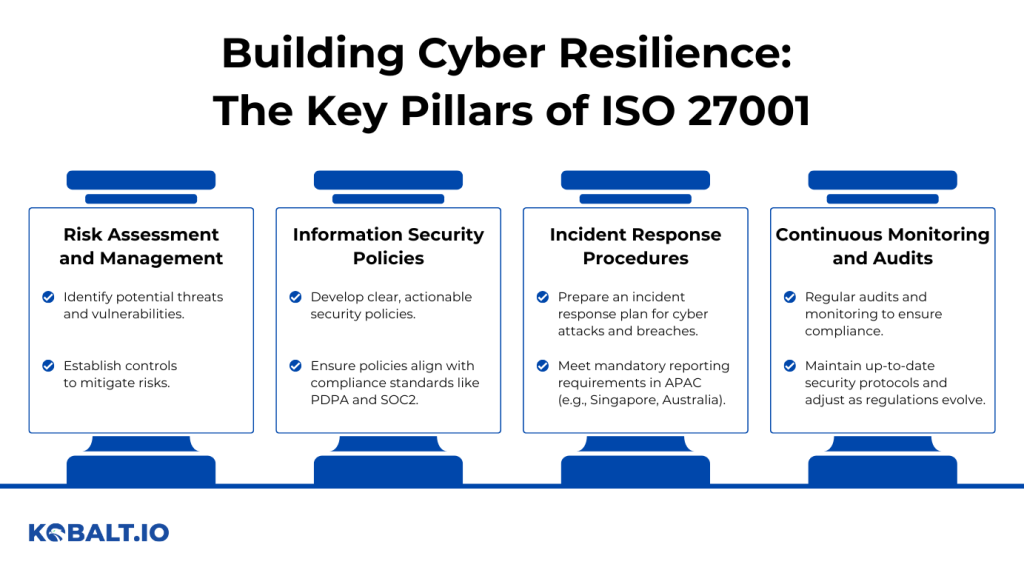
ISO 27001 is an internationally recognized standard that systematically helps organizations manage cybersecurity risks. It provides a structured framework that enables businesses to identify, assess, and mitigate risks to their information assets.
This framework covers practices from data access and encryption policies to incident response and security audits. ISO 27001 promotes a consistent, organization-wide approach to security, helping businesses stay resilient in the face of emerging threats.
Why It Matters in APAC
For organizations operating in APAC, ISO 27001 offers a unified approach to security that addresses the region’s diverse regulatory environment. Maintaining compliance can be complex and costly with countries like Singapore, Australia, Japan, and South Korea each having distinct data protection laws. ISO 27001 helps you establish a baseline for security controls that can satisfy multiple regulatory requirements across APAC.
By aligning with ISO 27001, businesses create a foundation that supports compliance with specific regulations, such as Singapore’s PDPA, South Korea’s PIPA, and Australia’s Privacy Act. This alignment reduces operational friction and positions organizations as security-conscious players across the region, making it easier to expand and operate in different APAC markets with greater confidence.
Use Case
In APAC, where trust and data privacy are especially important to consumers and regulators, ISO 27001 certification is a significant asset. For example, a health tech company across Singapore, Japan, and Australia can use ISO 27001 to demonstrate a consistent and proactive commitment to data protection across these markets.
Financial institutions operating in countries like Hong Kong and South Korea, where regulatory scrutiny is particularly high, benefit from ISO 27001 as it provides a common security standard that supports compliance with local requirements.
By adopting ISO 27001, organizations signal clients, partners, and regulators that they are committed to safeguarding sensitive information according to internationally respected practices. This trust factor can be particularly advantageous for your organization in highly regulated sectors like healthcare and finance, where cybersecurity is a priority and compliance is complex.
SOC 2 Compliance – Building Operational Trust for SaaS and Cloud Services

What It Covers
SOC 2 is a framework designed to help service providers, especially those in the tech and cloud spaces, meet certain standards in cybersecurity and operational practices. SOC 2 compliance concerns five trust service criteria: security, availability, processing integrity, confidentiality, and privacy.
Each criterion addresses a critical area of trustworthiness, covering aspects such as protection from unauthorized access, maintaining system uptime, ensuring complete and accurate data processing, protecting sensitive information, and handling personal data carefully. SOC 2 certification assures an organization has the controls to meet these requirements, creating a structured way to manage and demonstrate operational integrity and security.
Why It Matters in APAC
As cloud adoption rapidly accelerates across APAC, particularly in sectors like SaaS, prop tech, and fintech, clients and regulators are increasingly looking for reassurances that their data is handled securely. SOC 2 compliance provides you with a clear standard to address these expectations.
In countries such as Singapore and Australia, where data privacy and security regulations are becoming more stringent, SOC 2 certification helps you demonstrate a proactive stance on data protection and operational reliability. As a result, SOC 2 compliance is becoming a valuable credential for cloud-based service providers, who benefit from the ability to signal their commitment to secure, trustworthy service delivery across APAC.
Use Case
For businesses operating in data-sensitive industries in APAC, SOC2 compliance can play a significant role in meeting client expectations and regulatory demands. For instance, SaaS providers working with clients in Singapore and Australia—both countries with strong privacy laws—benefit from SOC 2 certification as it aligns with local demands for secure and reliable data handling.
This compliance standard helps you show that you have well-established controls to protect client information, manage availability, and uphold privacy commitments. As a result, SOC 2-certified businesses are often seen as more credible partners, appealing to privacy-conscious clients who prioritize security, especially in markets with high regulatory standards.
GDPR-Influenced Regulations in APAC – Adapting to New Privacy Standards

Regulatory Landscape
Several APAC countries have introduced data protection laws that reflect the EU’s GDPR principles. For example, Singapore’s Personal Data Protection Act (PDPA) and Australia’s Privacy Act emphasize core privacy rights for individuals, including the right to access and control their data and strong requirements around consent management and breach notifications.
These laws signal a shift toward greater accountability and transparency, requiring organizations to adopt clear policies for managing personal data. With more APAC nations looking to enhance their privacy regulations, this trend toward GDPR-like frameworks will likely grow, setting a higher bar for data protection across the region.
Compliance Opportunity
For organizations already experienced with GDPR, adapting to APAC’s GDPR-influenced regulations presents a valuable opportunity. Familiarity with GDPR principles such as data subject rights, explicit consent, and structured breach reporting can give these organizations a head start when working in countries like Singapore and Indonesia.
Leveraging GDPR knowledge helps streamline compliance efforts and reduces the need to build entirely new processes from scratch, making it easier to meet local requirements efficiently. This experience allows you to engage confidently in APAC markets, aligning their practices with local regulations without significant disruption.
Use Case
Organizations that proactively adopt GDPR-like standards across their APAC operations can reduce compliance risks and position themselves as leaders in data privacy. For instance, a multinational tech firm operating in Europe and Asia might apply GDPR-level privacy controls in Singapore, Australia, and Japan, even if local requirements differ slightly.
This unified approach simplifies compliance management across regions and builds a reputation for strong privacy practices, which resonates well with customers and regulators.
A Unified Strategy for APAC Cybersecurity Compliance
Bridging the Gaps
With APAC’s diverse and evolving regulatory landscape, you can benefit from a unified, hybrid compliance strategy. By using ISO 27001 as a foundation for security practices, SOC 2 for establishing operational trust, and GDPR-like frameworks to meet data privacy standards, businesses can create a structured approach that addresses key regulatory requirements across the region.
ISO 27001 provides a baseline for managing security risks, SOC 2 adds operational accountability and GDPR-inspired frameworks cover individual privacy rights and consent requirements. These standards offer a balanced framework that can be adapted across APAC’s different regulatory environments, helping you meet multiple local compliance expectations without duplicating efforts.
Operational Benefits
Adopting a unified strategy like this reduces the complexity of managing separate compliance programs for each APAC market. By aligning with ISO 27001, SOC 2, and GDPR-inspired frameworks, you can create a streamlined compliance model that fulfills common regulatory requirements and reduces operational redundancy.
This approach allows businesses to maintain consistent security and privacy standards, meet customer expectations, and optimize internal processes. Over time, this consistency reduces compliance-related costs and minimizes the resources needed to respond to various regulatory changes, making it a practical solution for your organization expanding across APAC.
Use Case
For financial institutions and SaaS companies looking to expand across APAC, a unified compliance model based on ISO 27001, SOC 2, and GDPR-inspired frameworks can bring significant efficiencies. For example, a SaaS provider entering markets like Singapore, Japan, and Australia can rely on ISO 27001 to cover foundational security, SOC 2 to assure clients of their operational practices, and GDPR-inspired standards to meet privacy expectations.
This unified strategy simplifies compliance efforts, allowing the company to focus more on growth and client service rather than juggling separate regulatory demands. With this framework, companies in highly regulated industries can achieve compliance while reducing administrative overhead and building trust with clients across multiple markets.
Conclusion
Meeting APAC’s diverse regulations doesn’t have to be overwhelming. Using a unified strategy with ISO 27001, SOC 2, and GDPR-inspired frameworks, you can simplify compliance, strengthen security, and build customer trust. Kobolt.io’s advisory services help you turn compliance into a strategic advantage.
See how our SOC 2 compliance services fit into a multi-framework program across APAC markets.