
Your first penetration test is an important milestone in strengthening your overall security posture. It gives you a clear view of identified vulnerabilities, helps your team grow their skills, and supports a thoughtful approach to continuous improvement. When done well, a penetration test becomes more than a test; it becomes an important part of your culture and security.
Prepare Before You Penetration Test
The more you prepare, the more meaningful your penetration test results will be.
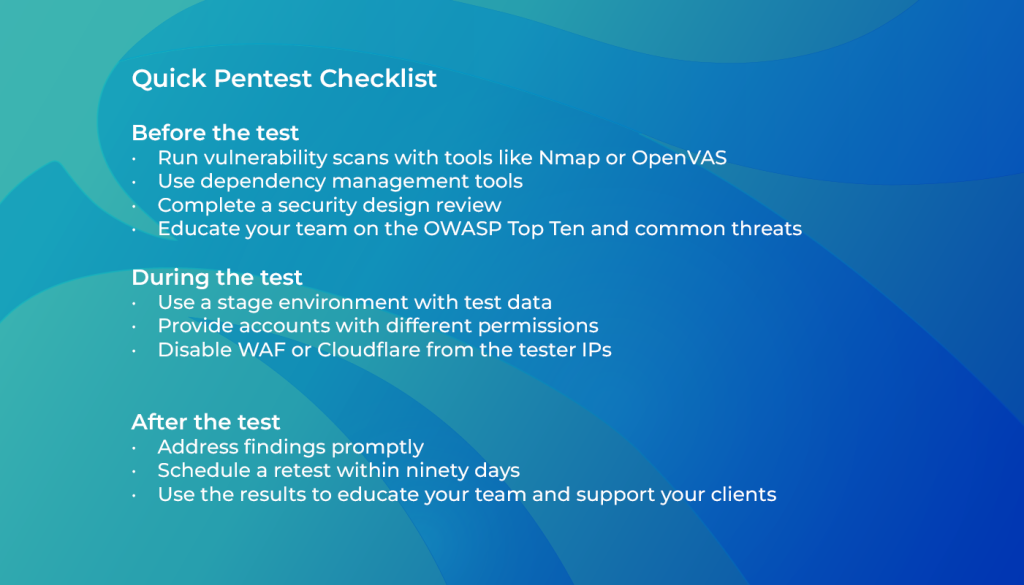
- Run early scans with security tools. Using tools like Nmap, OpenVAS, Nessus or similar platforms helps you discover potential security issues before your engagement begins. Early scanning also supports smoother vulnerability assessment activities later in the process.
- Use dependency management tools within your development workflow. Tools such as Dependabot or Snyk can help you reduce security vulnerabilities in libraries and frameworks before they reach production.
- Complete a security design review if your budget allows. Reviewing architecture early supports better access controls, more effective security measures, and improved protection for your web applications.
- Support team education. Explore OWASP learning resources and the OWASP Top Ten to build a deeper understanding of common risks in modern applications. This can make your first penetration test more focused and help your security teams respond quickly to any identified findings. Larger teams may also consider Security Development Training or DevOps Security Assessments.
These steps strengthen your security posture and help provide the most value through clear scope, relevant test data, and effective risk assessments.
During the Penetration Test
Stage environments are your friend. Testing in production environments introduces unnecessary risk.
- Begin with a proper stage environment that mirrors production but uses test data. This gives you realistic conditions while avoiding exposure of sensitive information or the chance of a data breach.
- Provide accounts with different permission levels. This allows the security testing process to uncover access controls issues that might otherwise be missed.
- Temporarily adjust protective services such as WAF or Cloudflare from our source IPs. This allows us to evaluate the application directly rather than the external security controls.
With Kobalt.io, Penetration Testing includes a kickoff call to confirm scope, one to two weeks of testing, and a clear report that outlines identified vulnerabilities and recommended next steps. Teams with newer applications or limited prior testing may discover more security issues, while teams that already use good security measures may see fewer items.
After the Penetration Test
Follow up is just as important as the test itself.
- Once you complete your fixes, Kobalt.io recommends scheduling a retest to confirm that the issues have been resolved. If your team completes the updates within ninety days, Kobalt.io offers a discounted retest at twenty percent of the original cost. This clean report can help support sales processes, reassure clients, and demonstrate your commitment to protecting data and preventing cybercriminals from causing harm.
- You can also strengthen your long-term cybersecurity posture by investing in an ongoing security program. A virtual CISO (vCISO) gives your team consistent guidance, practical recommendations, and support as your business grows. You can learn more about how our vCISO program works here.
After the Penetration Test
A penetration test is not just a checklist. It is an opportunity to improve your applications, refine your security measures, and strengthen your overall security posture. Preparing early, collaborating during the engagement, and following up with thoughtful vulnerability management helps you reduce risks while supporting your team’s growth.
Tip:
Treat your penetration test as a learning experience. Every finding is a chance to improve and continue building a strong and resilient approach to cybersecurity.
Ready to scope yours? Our penetration testing services start with a free 30-minute scoping call and a fixed quote.