Most companies we work with buy a pentest for a reason that has little to do with attackers. An enterprise customer wants to see one before signing. The SOC 2 auditor expects one. The insurer asks for it at renewal. The report comes back with a few mediums and a couple of highs, the team fixes them, and the deal moves forward.
That annual test isn’t wrong. It’s often scoped for a world where deep attacks were expensive. AI has changed that math for attackers, and AI penetration testing now shows up in most vendor pitches. Most test scopes haven’t caught up. A clean report can still mean your application is in good shape. It can also mean the test never looked where today’s attackers look, and an enterprise security team that asks harder questions will notice the gap before you do.
AI made deep attacks cheap
For most of the last twenty years, a deep attack on one mid sized company took real effort. Someone skilled had to spend days learning your application: the roles, the permissions, how billing or onboarding works, and where the logic breaks. Most opportunistic attackers stuck to easier targets, like known vulnerabilities, default passwords and exposed admin panels.
The cost has dropped sharply. In September 2026, AI agents ran 105 attack projects, including against online retailers, over about six days at an average cost of around $25 per target, according to Gambit Security’s analysis of the operation.
The harder flaws are getting cheaper to find as well. In May 2026, Google’s threat intelligence team reported what it believes is the first zero day exploit developed with AI, disrupted before a planned mass campaign. The attacker still needed valid credentials to use it, and the flaw itself was a logic error in a two factor authentication check: the kind of thing that used to take a patient human to spot.
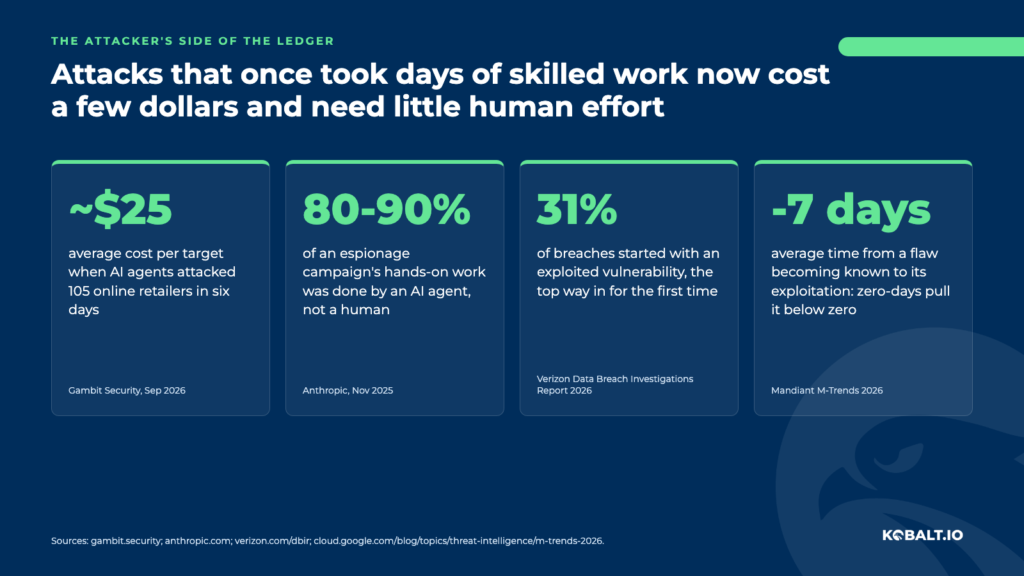
For a 60 or 150 person company, the implication is about scope. Your test needs to cover the logic and permission flaws that are now cheap to look for, not only the common patterns.
Not every penetration test goes to the same depth
The word pentest covers a wide range of work, and the report doesn’t always make clear which kind you bought. Most application tests fall into one of three depths, all built on standards from OWASP, the Open Worldwide Application Security Project.
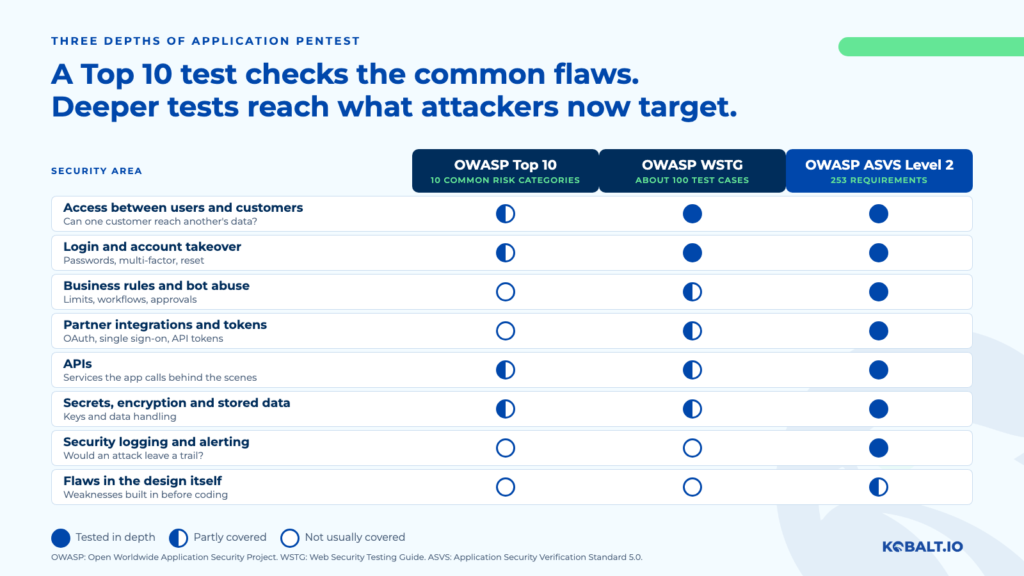
OWASP Top 10. OWASP describes the Top 10 as an awareness document, not a verification standard, but many tests are scoped against it because it’s familiar and fits a short engagement. It finds common issues with a recognizable pattern well: injection, misconfiguration, outdated components.
OWASP Web Security Testing Guide (WSTG). The WSTG is a full testing methodology covering authentication, session management, authorization and business logic. If your product is your business, this is the realistic minimum.
OWASP Application Security Verification Standard (ASVS) Level 2. ASVS is a verification standard rather than a test plan, and OWASP recommends Level 2 for any application that handles sensitive data. That covers most SaaS and nearly all of fintech. Testers check how access control, data protection and the architecture actually work, beyond whether a scanner gets a hit.
The gap between the first and the third sits in the areas that are hardest to automate and most valuable to an attacker: authorization, multistep workflows and business logic. Think of a user in one customer account reading another customer’s invoice by changing an ID, or someone approving their own payout by replaying requests in a different order. Those findings used to be expensive for attackers because they needed a human who understood the application. AI agents are now learning to probe for them, cheaply and at scale.
What an attacker targets at a fintech and a SaaS company
Picture two typical companies.
A 60 person fintech runs a web and mobile app that lets small businesses manage payments and payouts. It has a few bank and processor integrations, a SOC 2 Type 2 report, and an annual Top 10 pentest that keeps the auditor and bank partners happy. Last year’s report had nothing critical.
A 150 person SaaS company runs a multitenant B2B platform. Enterprise customers ask harder security questions every quarter, and the team ships to production a few times a day. It also runs an annual pentest scoped to the Top 10.
For the fintech, an AI assisted attacker won’t start with SQL injection on the login page, which the Top 10 test probably covered. It will go after the payout approval flow. Can someone add a user to a business they don’t own? Can a payout change between approval and execution? Does the API enforce the same limits as the UI?
For the SaaS company, the target is tenant isolation: an API the front end never calls that lets one customer list another customer’s records, or the export feature shipped in March that checks permissions differently from the rest of the app.
To be fair to the Top 10, broken access control sits at number one on the current list. A Top 10 test usually checks it lightly, though, with one or two accounts and little time to learn how the business works. Working through every role, every tenant boundary and every step of a payout flow is WSTG and ASVS work.
We saw this with a SaaS company this year. Its earlier pentests, scoped to the Top 10, came back mostly clean. The issues that later caused real pain were permission flaws, with users reaching parts of the platform they shouldn’t have, all of it outside what the tests had been scoped to cover.
Where AI penetration testing helps, and where it falls short
AI should make testing cheaper too, and partly it does. We use AI in our own testing. AI pentesting and automated penetration testing tools are very good at breadth: crawling large applications, running thousands of test variations, reading code for known bad patterns and drafting findings. It makes good human testers noticeably faster. This is about AI as the tester. Testing your own AI features is a different job, covered in our guide to penetration testing for AI systems.
As a replacement for a human led test, it has real limits.
Noise at volume. XBOW, an autonomous testing system, reached number one on HackerOne’s US leaderboard in 2025. Of the roughly 1,060 reports it submitted, 130 had been resolved at the time of its write up, and about 400 more were closed as duplicates or informative, even with its own security team reviewing every report before submission. Hand your engineers a long list that’s mostly noise and they’ll spend a week proving it, then trust the next report a little less.
Business logic is the blind spot. AI tools are strongest where a finding has a recognizable shape and weakest where it depends on what your business considers allowed: who can approve a payout, which roles can see which tenant’s data, what a valid refund looks like. An agent won’t know your viewer role and shouldn’t be able to trigger an export unless someone tells it, and in an automated scan nobody usually does.
It only tests what it can reach. Automated agents often stall at authentication, MFA, multistep onboarding or anything that needs a second user in a second tenant. That’s where the expensive flaws tend to live.
Clean reports look alike. A tool that never got past the login page and a skilled tester who worked through every role can both report no critical findings, and you’ll hand that PDF to an auditor or a board either way.
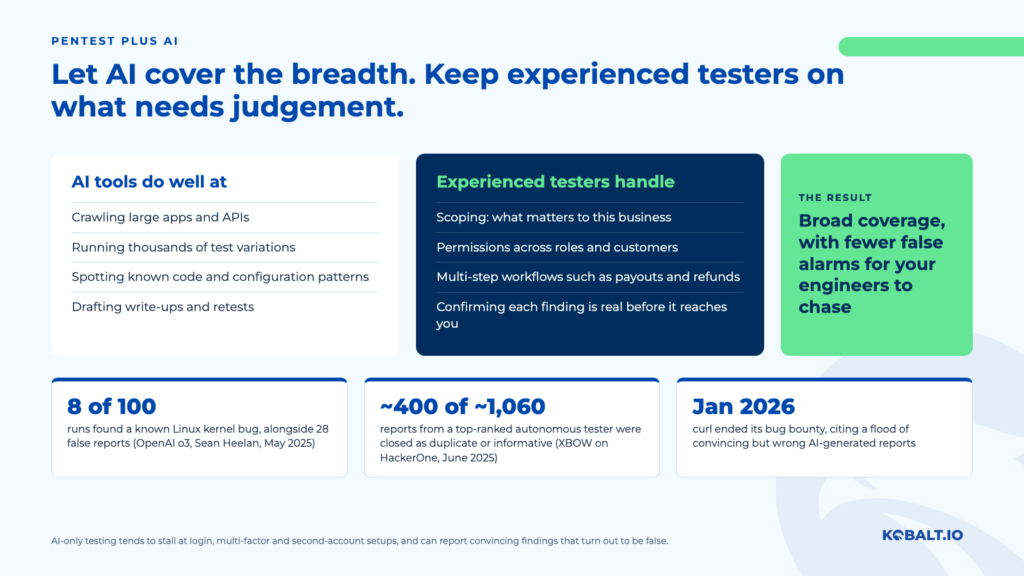
The practical reality is that you need a human led pentest with AI doing the breadth work. AI handles the repetition, while an experienced tester owns scoping, business logic, authorization and the call on whether a finding actually matters. Good testing teams already work this way, and it’s a fair question to ask any vendor.
Continuous penetration testing after a deep baseline
The pace on your side has changed too. The annual pentest assumed your application looked much the same in month eleven as in month one. Teams now ship more code, faster, and a growing share of it is written with AI assistants that are confident but not always right about access control.
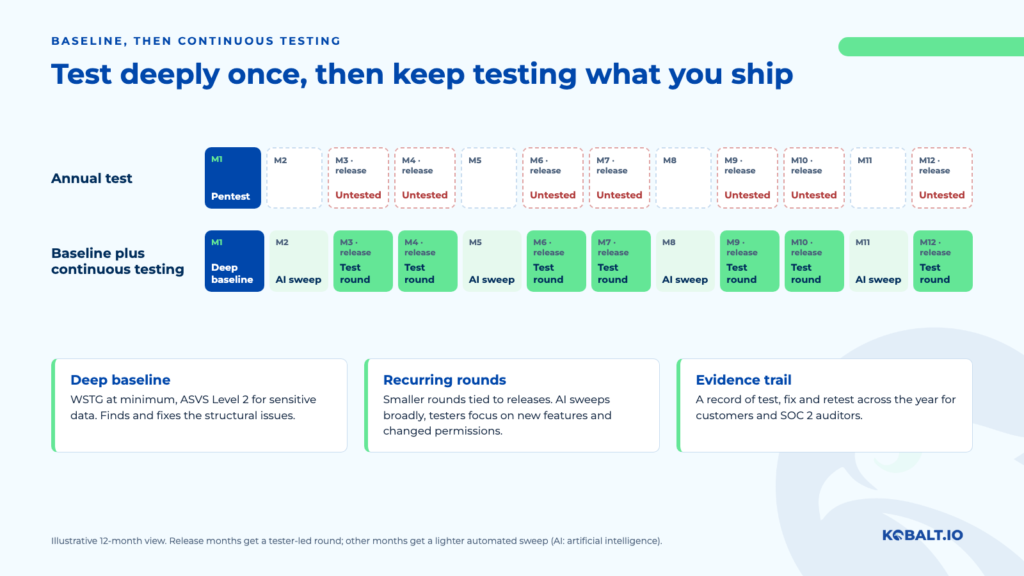
The model that holds up is a deep baseline first, then continuous testing on top of it. Start with WSTG at minimum, or OWASP ASVS Level 2 if you handle sensitive data. The baseline shows where you stand and fixes the structural issues. Regular penetration testing in smaller rounds, tied to what you’ve shipped, keeps you from drifting back, with AI covering the broad sweeps and testers focused on new features and changed permissions.
For the fintech, the new instant payout feature gets tested the month it ships, not eleven months later. For the SaaS company, the new export and integration features get checked for tenant isolation before an enterprise customer’s security team finds the gap.
Continuous testing also builds a steady record that you test, fix and retest. For an enterprise security review or a SOC 2 auditor, that record carries more weight than one PDF from last spring.
For features that don’t exist yet, a security design review covers ground a pentest can’t. It looks at how a feature will work while it’s still a whiteboard sketch, and asks who can approve a payout, who can change that rule, and what would stop one compromised account from approving its own. Fixing it there costs a conversation instead of a release. Testing lowers the odds, but something can still get through.
Questions to ask about your last pentest report
If you already run an annual pentest, you’ve built the habit, and that’s the hard part. If you haven’t run one yet, start with what to expect from your first penetration test. The real question is whether the test still matches what attackers and enterprise buyers now look at. Start with your last report:
- Was it scoped to the Top 10, WSTG or ASVS? If the report doesn’t say, that’s an answer of its own.
- Did the testers have accounts in at least two tenants or roles, and test between them?
- How much of the work was automated, and who validated the findings?
- What have you shipped since, and has any of it been tested?
- Were the highs retested after the fix?
If any of those were hard to answer, it’s worth a conversation. Book a free scoping call and we’ll walk through what your last test covered, what it missed, and what a penetration testing program built for today’s attackers would add.
Michael Argast is CEO and cofounder of Kobalt.io.