Search
AI security services

AI Security and Governance Services for Growing Companies

Your enterprise customer just sent a security questionnaire with an AI section. Here's how to answer it without pulling your team off the product.

Will you train models on our data? Which AI vendors do you use? Who approves what your agents do? We help you put the inventory, the controls and the evidence in place, so the answer is ready when the question arrives.

Frameworks we work to ISO 42001 NIST AI RMF EU AI Act AIUC-1 OWASP Top 10 for LLM Applications
AI security basics

The AI questions your enterprise buyers are asking

AI governance is how your company decides which AI tools it uses, what data goes into them and who answers for what they do. Enterprise buyers now check it in their security questionnaires, and the same themes keep coming up. You don't need a certificate to answer most of them. You need evidence.

Training on customer data

Will you train AI models on our data? It's usually the first question, and buyers want the answer in writing.

AI vendors and models

Which models and AI vendors sit behind your product and your team's tools, and what their terms say about customer data.

Prompt and output retention

How long prompts and outputs are kept, and whether a person ever reads them.

Agents and connectors

What your AI agents can reach, who approves their actions and how you switch one off.

Named frameworks

Whether you follow ISO 42001, the NIST AI Risk Management Framework or the EU AI Act, and can show how.

Security of the AI itself

How you test for prompt injection and data leakage before a release.

Where to start

Foundations, Core or Extended: which do you need first?

Three one-time engagements, sized to how far AI reaches into your business.

Foundations

Start here
The starting point
Start here ifAI is in use, little is written down
You getAI policy pack, approved tools register, staff training
We reviewUp to 4 AI vendors
Framework mapISO 42001 and NIST AI RMF
TimelineAs little as 2 weeks

Core

Everything in Foundations, plus
Start here ifAI tools reach email, files or code
You getAI risk register, hardening guide, tabletop exercise
We reviewUp to 10 vendors in total, 10 connectors and MCP servers
Framework mapIncluded
TimelineAs little as 4 weeks

Extended

Everything in Core, plus
Start here ifAI agents act on their own
You getAgentic risk assessment, approval matrix, board readout
We reviewNon-human identities, credential scope, shadow AI
Framework mapIncluded
TimelineAs little as 4 weeks
Our process

We get you questionnaire-ready in as little as 2 weeks, and keep you there

1

Discovery

We inventory the AI tools and connections your team uses, and read the AI questions your customers have sent. No guesswork.

2

Build

We write the AI policy on top of the policies you already have, build the approved tools register and assess your AI vendors.

3

Evidence

We hand over the evidence that sits behind your answers: the policy, the register and the vendor assessments.

4

Stay current

A monthly program keeps the register up to date, reviews new vendors and connectors every quarter and tells you when a vendor changes its terms.

The Kobalt squad

This isn't a policy template. It's an AI security program run by people who do this every day.

Your AI risk register loads into the compliance platform you already run, whether that's Vanta, Drata or Scrut. No new tool to buy.

vCISO: strategic leadership

Guides your AI risk decisions with your leadership and reviews the policy before you approve it.

Security analyst: policy, vendors, evidence

Writes the policy, assesses your AI vendors and connectors, and builds the evidence your customers ask for.

Project manager: delivery and coordination

Keeps the engagement on schedule and gives you one person to call.

The DIY question

"We can just write an AI policy with ChatGPT, right?"

You can draft a policy that way. Plenty of teams do.

Then the questionnaire arrives, and it doesn't ask whether you have a policy. It asks for what sits behind it.

A policy written in an afternoon can't answer that. And it goes stale the first time someone connects a new tool.

That's the part we run with you: vendors assessed, a register kept current and a map to the frameworks your customers name.

What your customer asks to see

  • The AI vendors you assessed
  • Your approved AI tools list
  • How long prompts and outputs are kept
  • Who approves what your agents do
  • Your staff training records
Right for where you are

Three ways to get started

Staying ready

Monthly AI security program

AI Security Essentials or AI Security Managed, on a 12-month term. Your answers stay true as your tools change.

  • Register kept current
  • New vendors and connectors reviewed every quarter
  • Alerts when a vendor changes its retention, data-use or subprocessor terms
  • Annual policy and training refresh
Talk about staying ready
Building AI

AI Security for Builders

A monthly program on a 12-month term, for teams with AI features or agents in the product or customers in the EU.

  • EU AI Act readiness: risk classification and technical documentation
  • Evaluation gates and change control for prompts and models
  • Model and agent inventory, with connectors re-vetted continuously
  • Builders + Certification adds ISO 42001 readiness and the internal audit
Talk about your product
Is this for you?

You're probably in one of these situations

A questionnaire has an AI section

Your biggest prospect wants to know whether you train on their data and which models you use. The deal waits on the answer.

The board asked about AI

Investors or your insurer want to know how you govern AI, and nobody owns the answer yet.

Your team uses AI without rules

ChatGPT, Copilot, a meeting note-taker, the AI inside your CRM. Nobody is sure which tools hold company data. That's shadow AI, and customers ask about it either way.

You're shipping AI features

AI is in your product, you sell into Europe, and customers ask how the system itself is secured.
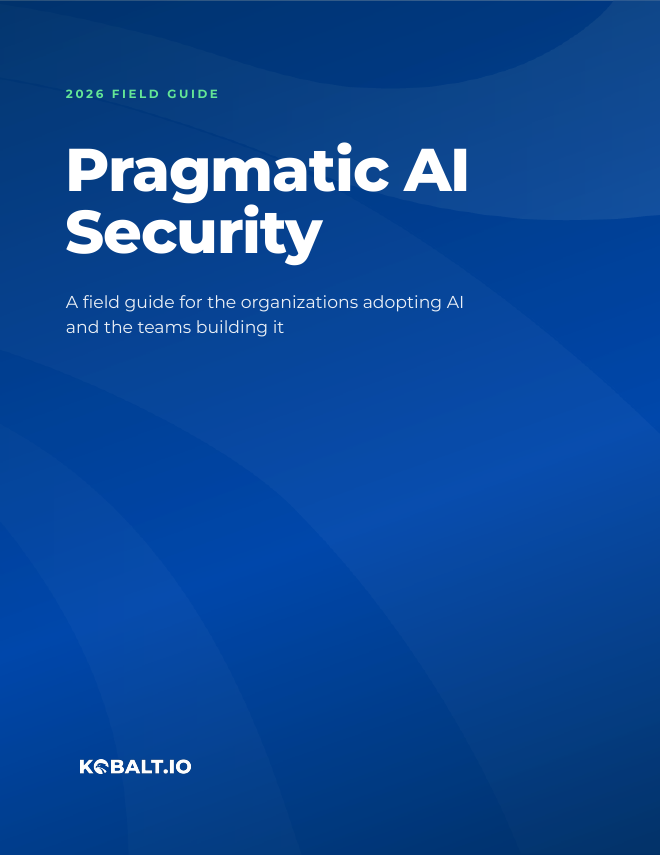
Cover of Pragmatic AI Security, a field guide from Kobalt.io
Free field guide

Not sure where you stand yet? Start with the field guide.

Pragmatic AI Security is a practical guide for companies adopting AI and teams building it.

  • How to find the AI tools already in use
  • A 90-day plan you can start this week
  • Three worksheets: discovery, vendor vetting, agent approvals
Speak with an expert

Bring us the AI questions your customers are asking

Pick a time that works for you. If a customer has already sent a questionnaire, bring it to the call.

Common questions

Frequently asked questions about AI security

What do enterprise customers ask about AI in security questionnaires?
Most ask whether you train AI models on their data, which AI vendors and models you rely on, how long prompts are kept and how you control AI agents. Many also ask which framework you follow: ISO 42001, the NIST AI Risk Management Framework or the EU AI Act.
How long does an AI security engagement take?
A Foundations engagement takes as little as 2 weeks. Core and Extended take as little as 4 weeks. Monthly programs run on a 12-month term.
How much do AI security services cost?
One-time engagements start at $5,000 USD. Monthly programs start at $650 USD a month. We confirm scope and price after a first call.
We already have an AI policy. Do we still need this?
Your policy is the starting point, and we build on it. Questionnaires ask for what sits behind the policy: the vendors you assessed, your approved tools list and your training records.
Doesn't our compliance platform already cover AI?
Your compliance platform tracks controls and evidence. It doesn't assess your AI vendors or write your AI use policy. The AI risk register we build loads into the platform you already run, whether that's Vanta, Drata or Scrut.
Does Kobalt.io certify companies to ISO 42001?
No. We prepare you for certification, run the internal audit and sit beside you in the audit. An accredited certification body issues the certificate.
Can you test the AI in our product?
Yes. With a specialist testing partner, we run AI application penetration tests that follow the OWASP Top 10 for LLM Applications, and AI security design reviews. Your contract is with Kobalt.io, and each test is scoped and quoted on its own. See penetration testing.
Does Kobalt.io use AI to deliver this?
Yes. Kobalt.io specialists use Kobalt-built AI tooling to prepare drafts, and an expert reviews every deliverable before you see it. We do not take passwords, health data or card data into the work.